 Home link
Charles University, Third Faculty of Medicine
Physiotherapy plays an irreplaceable role in the treatment of neurological disorders. High-quality education of physiotherapists can significantly improve patient care and, consequently, the quality of life of people with neurological conditions. To achieve this, it is essential to find effective and innovative educational approaches.
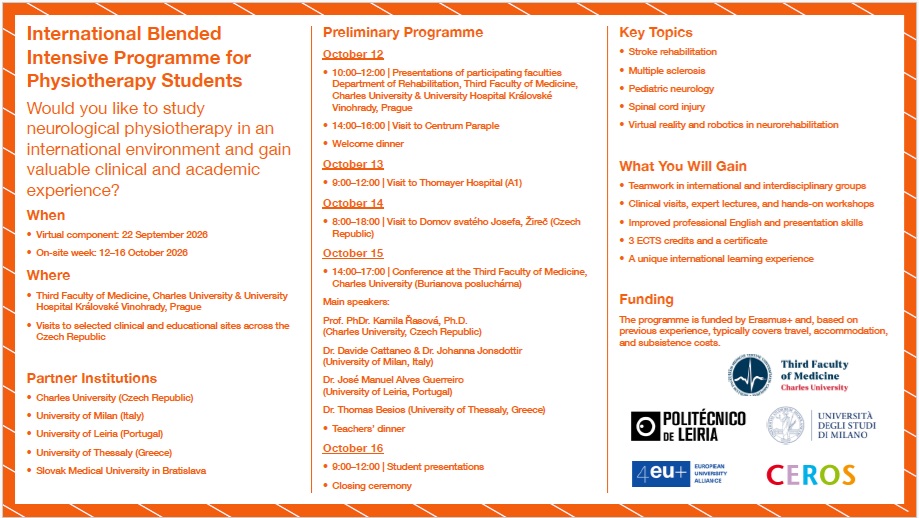
One such approach is the Blended Intensive Programme (BIP)—a one-week international course supplemented with virtual activities, involving participation of at least three universities. These institutions will deliver expert lectures by clinicians and researchers specializing in neurorehabilitation, bringing new knowledge and modern therapeutic methods into physiotherapy curricula. The program will also allow students to collaborate internationally, enhancing language skills and intercultural competence.
Active engagement in international student teams will strengthen students’ communication skills and ability to present their work. Students will form six international groups, each responsible for preparing and presenting a lecture and a scholarly article on topics such as stroke rehabilitation, multiple sclerosis, Parkinson’s disease, pediatric neurology, spinal cord injury rehabilitation, virtual reality, and robotics. Participants will also visit specialized clinical centers to gain insight into neurologically focused care.
This project builds upon previous successful collaboration: the first BIP was held in Kuopio, the second in Prague, and the third in Lamia. The most recent BIP in neurorehabilitation took place on 13–17 May 2024 at the Third Faculty of Medicine, organized by Prof. Kamila Řasová, Ph.D., and attended by 36 students and academics from Charles University, the University of Kuopio (Finland), the University of Thessaly (Greece), and Izmir Bakircay University (Turkey).
The aim of the project is to enhance physiotherapy education in neurological rehabilitation by connecting clinical and scientific expertise of international specialists. Additional objectives include developing language, communication, and presentation skills among students, strengthening multidisciplinary and international collaboration, providing practical clinical experiences, and integrating innovative neurorehabilitation methods into the curricula of all participating universities.
